NPD examples – Product and Brand Management
Introduction
In today’s dynamic business environment, organizations must continuously innovate to remain competitive. Customer preferences change rapidly, technology evolves, and new market opportunities emerge regularly. As a result, companies need to introduce new products and improve existing offerings to meet market demands.
New Product Development (NPD) is the process through which businesses generate ideas, evaluate opportunities, develop products, test them in the market, and launch them commercially. A successful NPD strategy helps organizations create value for customers, achieve business growth, and build sustainable competitive advantages. For MBA and MMS students, understanding NPD is essential because innovation plays a crucial role in marketing, product management, and brand development.
What is New Product Development (NPD)?
New Product Development refers to the systematic process of bringing a new product or service to the market. It involves identifying customer needs, generating innovative ideas, developing concepts, conducting market testing, and finally commercializing the product.
The primary objective of NPD is to create products that satisfy customer requirements while contributing to organizational profitability and growth.
Why is New Product Development Important?
Businesses engage in new product development for several reasons. Market conditions are constantly changing, and organizations must adapt accordingly.
Key reasons for NPD include:
- Change in market needs
- Entry into new market segments
- Environmental changes
- Development of new concepts
- Technological advancements
- Changes in customer preferences
- Building on existing success and growth opportunities
Benefits of New Product Development
- Enhances customer satisfaction
- Creates competitive advantage
- Supports business growth
- Expands market share
- Improves brand value
- Generates new revenue streams
- Encourages innovation
Furthermore, successful product innovation helps businesses remain relevant in highly competitive markets.
Product Life Cycle and Marketing Strategies
Every product passes through different stages during its market journey. These stages collectively form the Product Life Cycle (PLC). Each stage requires different marketing strategies regarding product, price, place, and promotion.
1. Introduction Stage
At this stage, the focus remains on creating awareness and encouraging product trials.
Strategies:
- Focus on the product itself
- Premium, penetration, or economic pricing
- Selective distribution
- Selective promotion
2. Growth Stage
As customer acceptance increases, the product enters the growth stage.
Strategies:
- Focus on product features, advantages, and benefits (FAB)
- Increased distribution
- Heavy promotional activities
- Market expansion efforts
3. Maturity Stage
During maturity, competition intensifies and market growth slows.
Strategies:
- Emphasis on service offerings
- Competitive pricing
- Selective distribution
- Limited promotional activities
4. Decline Stage
Sales gradually decrease during the decline stage.
Strategies:
- Focus on survival and profitability
- Low pricing
- Reduced distribution
- Minimal promotional support
These strategies help organizations maximize product performance throughout its life cycle.
Philip Kotler’s New Product Development Process
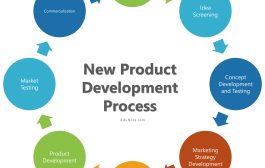
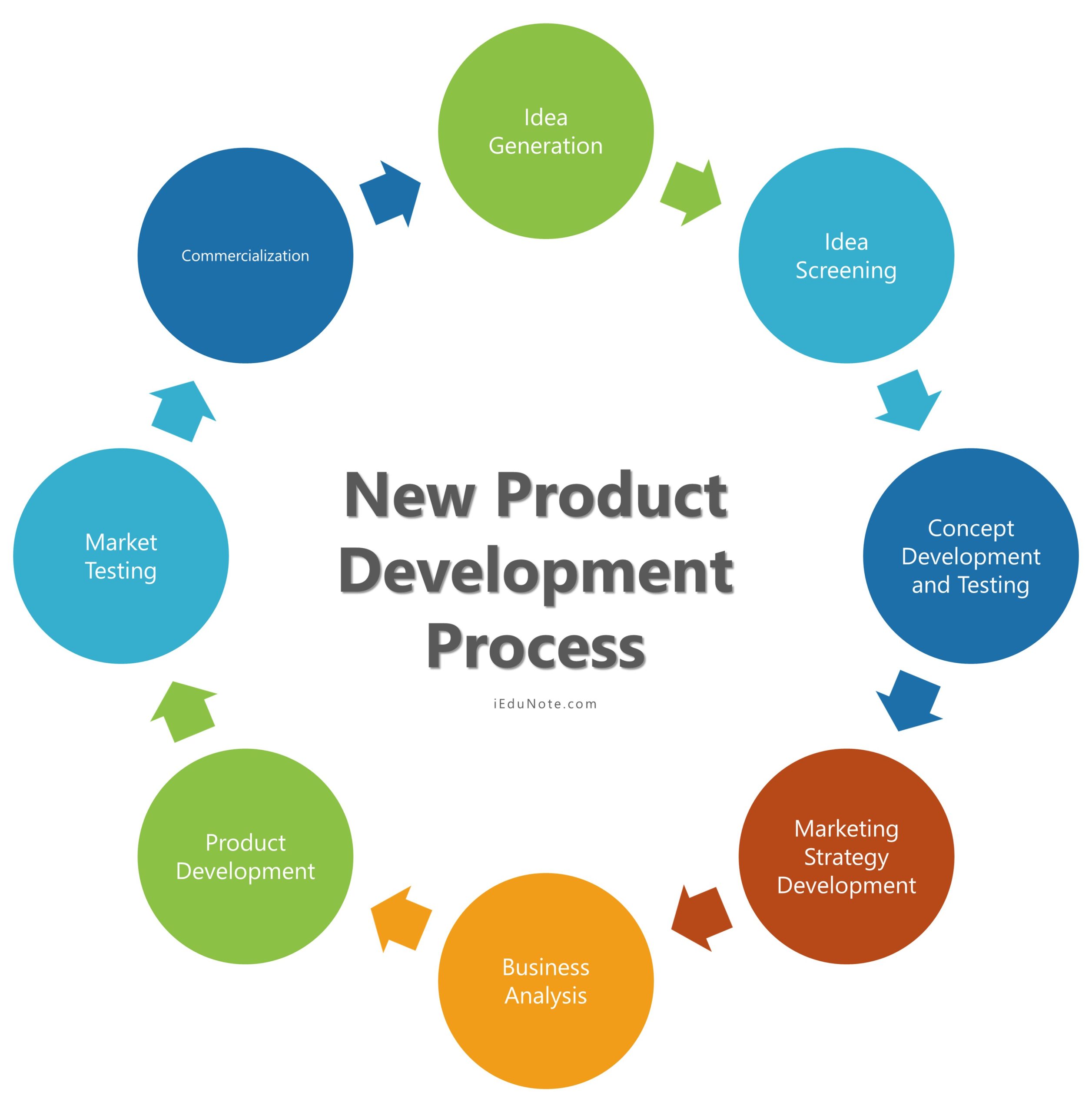
According to Philip Kotler, the NPD process consists of eight stages. Each stage reduces uncertainty and improves the likelihood of product success.
1. Idea Generation
The first stage involves generating innovative product ideas from customers, employees, competitors, research institutions, and market trends.
Sources of ideas include:
- Customer feedback
- Market research
- Technological innovations
- Employee suggestions
- Industry developments
2. Idea Screening
Once multiple ideas are generated, businesses evaluate and filter them.
The objective is to eliminate weak ideas and focus on those with strong market potential.
3. Concept Development and Testing
Selected ideas are transformed into product concepts.
Subsequently, these concepts are tested with potential customers to assess acceptance, usability, and perceived value.
4. Marketing Strategy Development
At this stage, organizations develop plans related to:
- Target market
- Positioning
- Pricing
- Promotion
- Distribution
A strong marketing strategy improves the likelihood of successful product adoption.
5. Business Analysis
The feasibility of the product is assessed through:
- Cost estimation
- Revenue projections
- Profitability analysis
- Competitive evaluation
6. Product Development
The actual product is designed and developed.
This stage includes:
- Prototype creation
- Technical development
- Packaging design
- Quality testing
7. Test Marketing
The product is launched in a limited market to evaluate customer response.
Feedback obtained during this phase helps organizations make improvements before a full-scale launch.
8. Commercialization
Finally, the product is introduced to the broader market through large-scale production and distribution.
At this stage, businesses invest significantly in marketing, sales, and distribution activities.
New Product Development Example: Cocotang India
Cocotang India provides an excellent example of successful new product development. The idea originated when Dr. Neelima T. observed the health benefits of coconut water during her pregnancy. This personal experience inspired the development of coconut-based beverages.
Application of the NPD Process
Idea Generation
The concept emerged from understanding the health benefits of coconut-based products.
Idea Screening
Market demand was assessed among health-conscious consumers, vegans, and lactose-intolerant individuals. Additionally, the company focused on natural ingredients and compliance with health standards.
Concept Development and Testing
Coconut milkshakes and mocktails were developed and pilot-tested to gather customer feedback.
Business Analysis
The company evaluated consumer preferences, pricing strategies, and profitability potential.
Product Development
Product flavours were refined while eco-friendly packaging was introduced to align with brand values.
Test Marketing
Kiosks and walk-in stores were used to evaluate market acceptance and collect feedback.
Commercialization
The company expanded through online stores, cloud kitchens, and additional retail outlets.
New Product Development Example: The Black Box Co.
The Black Box Co. identified an unmet market need in personalized gifting for men. The founders questioned why gifting options largely focused on women and sought to create customized gifting solutions for male consumers.
Application of the NPD Process
Idea Generation
The business identified opportunities in personalized gifting products.
Concept Development
The founders developed the concept of personalized gift boxes, which inspired the brand name “The Black Box Co.”
Marketing Strategy
Social media platforms were selected as the primary promotional channel.
Business Analysis
The founders assessed business feasibility based on their complementary strengths in creativity and brand building.
Product Development
The company developed personalized products across categories such as office accessories, travel products, lifestyle items, and beverages.
Test Marketing
Initial testing focused on office gifting products before expanding the range.
Commercialization
The business successfully expanded into multiple product categories and generated substantial online and offline orders.
New Product Development Example: Bisleri
Bisleri’s development journey demonstrates how innovation can strengthen an established brand. The company focused on providing purified and safe packaged drinking water through an improved purification process.
Application of the NPD Process
Idea Generation
The objective was to offer purified packaged drinking water.
Idea Screening
The company positioned the product around purity, safety, and mineral content.
Concept Development and Testing
A ten-step purification process was developed to ensure quality standards.
Business Analysis
The company recognized opportunities to expand the packaged drinking water market.
Product Development
Packaging innovations included transitioning from PVC to PET bottles and changing the packaging colour scheme.
Test Marketing
The company conducted market testing before broader rollout.
Commercialization
Finally, the product was mass-produced and made widely available across retail outlets.
Challenges in New Product Development
Although NPD offers significant benefits, organizations often face challenges such as:
- High development costs
- Market uncertainty
- Technological risks
- Intense competition
- Product failure rates
- Changing consumer preferences
Therefore, businesses must carefully evaluate opportunities before investing heavily in product development.
Future of New Product Development
Modern NPD is increasingly influenced by:
- Artificial Intelligence (AI)
- Data analytics
- Customer co-creation
- Sustainable innovation
- Digital prototyping
- Agile product development
Consequently, organizations can reduce development time while improving product-market fit.
Conclusion
New Product Development is a critical business process that enables organizations to respond to changing customer needs, technological advancements, and competitive pressures. Through systematic stages such as idea generation, screening, concept testing, business analysis, product development, test marketing, and commercialization, companies can transform innovative ideas into successful market offerings. Furthermore, examples such as Cocotang India, The Black Box Co., and Bisleri demonstrate how structured NPD processes contribute to innovation and business growth. Therefore, understanding NPD is essential for MBA and MMS students aspiring to build careers in marketing, product management, entrepreneurship, and brand development.